Straw-Burning Ban Lifted, Hebei Still Sticks to a Blanket Ban — How Do Smallholders See It?

This May, I went back to my hometown in southern Hebei and took the chance to look into how straw return has been going. When the folks back home heard why I’d come, they would go still for a moment first, wearing an expression that said: ‘What’s there to talk about?’ Call it bewilderment or call it resignation — their reactions were a tangle of several emotions —
They’ve been returning straw to the field for over a decade now — even if they didn’t want it, they’ve got used to it;
Of course they’d far rather burn the straw, but doing that could land you in detention;
Straw return really does cause a lot of problems and may even reduce yields — but so what? With grain prices this low, harvesting a hundred or two hundred jin less won’t make a difference. It’s like a person skipping one steamed bun — they won’t starve.
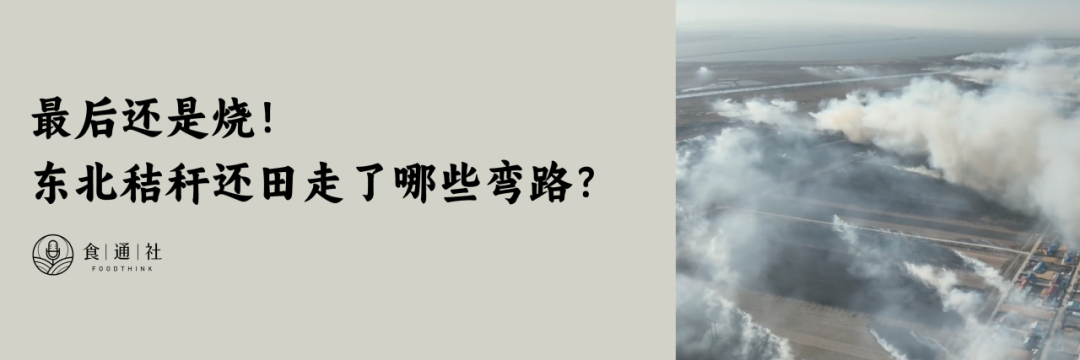
Before heading home, I had witnessed several scenes of straw burning in Heilongjiang. After ten years of forced straw return, farmers’ strong opposition led Heilongjiang Province to effectively lift the ban on straw burning last year, permitting farmers to burn in an orderly manner once they received instructions from higher authorities. Some other provinces have been going through similar changes. The Ecological Environment Code, which came into effect in August this year, also requires that ‘local governments at all levels shall strengthen the organisation, guidance and management of the burning of straw, fallen leaves and the like in a scientific and precise manner,’ marking a shift from a blanket ban on straw burning to a new phase of ‘scientific and precise burning.’
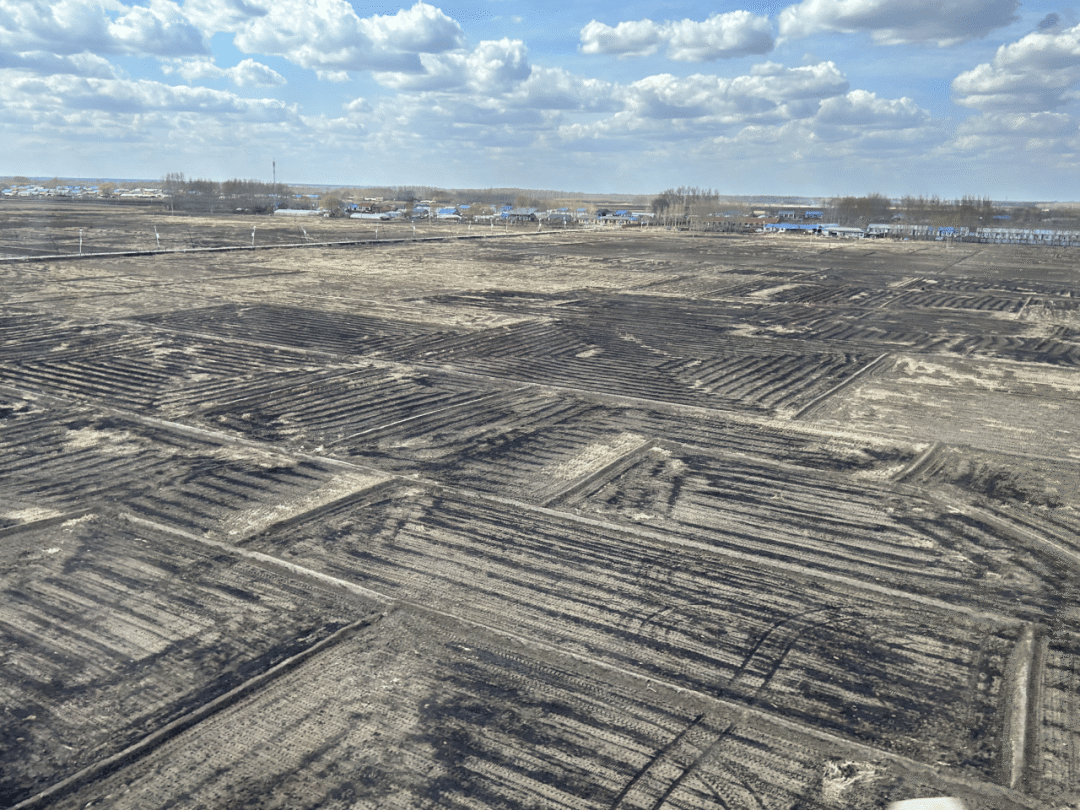
◉ Large tracts of farmland freshly burned, as seen by Foodthink in Heilongjiang at the end of April this year.
Yet compared with the Northeast, the lived reality for Hebei farmers is completely different. Every farmer I chatted with was unaware that other provinces are now conditionally permitting burning.
“Start a fire round here and they’ll put you in detention.” More than one farmer said it that way.
In other provinces, farmers tend to get worked up when the straw-burning ban comes up. But Hebei folk wear a look of calm detachment, say little, and carry a quiet, fatalistic resignation.
The North China Plain, where my family hails from, is a major grain-producing area that typically grows two crops a year — winter wheat and summer maize. Compared with the many problems I saw straw return causing in other provinces, things have gone relatively smoothly here in Hebei, with no glaring conflicts. So what accounts for this? Is it that straw return aligns more closely with the climate, the crop types and the cropping system here? Or is it that, with the burning ban enforced most strictly of all, farmers have spent over a decade working out effective ways to cope?
I. Sowing
Farmers’ main grievances with straw return today come down to two things: it hampers sowing and invites pests and diseases.
Wheat straw is easy enough to handle. Most farmers say the stems are thin, soft and short, so the harvester chops them up and spreads them straight across the surface, and that’s that — what’s known as surface mulch return. Come the maize season, a four-legged no-till seeder rolls through, tilling and sowing each row in a single pass. The wheat straw stays between the maize rows, and even the top 20 centimetres of the wheat roots remain anchored in the soil. ‘Leave it all there — it conserves soil moisture,’ the old-timers say.
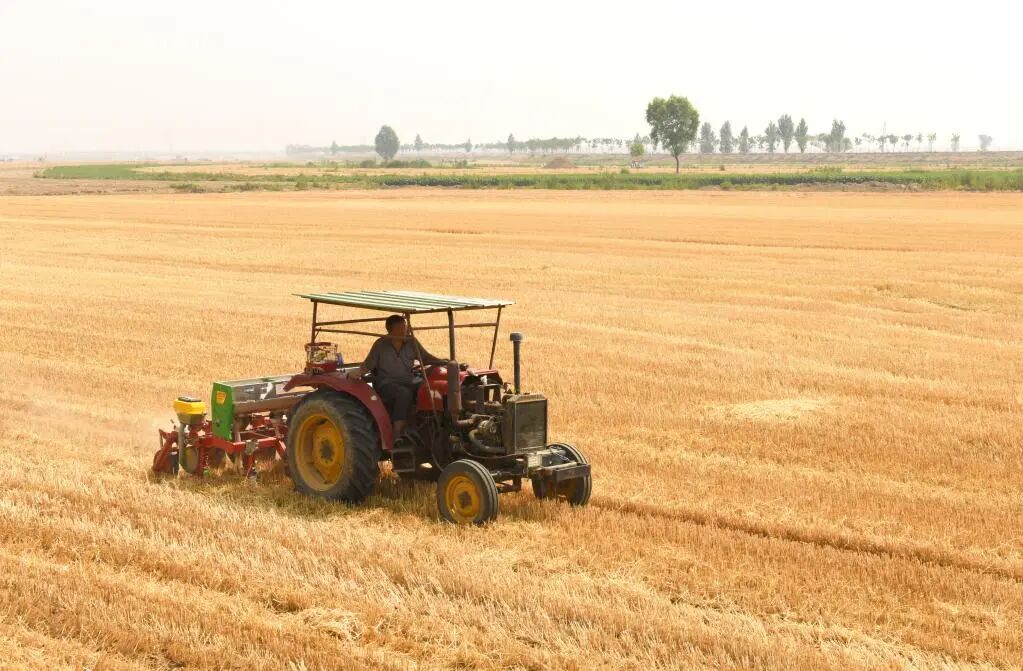
◉ A farmer in Xingtai, Hebei, sowing maize by the no-till method in a freshly harvested wheat field. Photo credit: Xinhua
It’s the maize straw that’s the headache — simply too much of it. A farmer in Quzhou put it bluntly: ‘These days maize is planted so thick, and the stalks grow so tall — put it all back in the ground and there’s no way to manage it.’ So some farmers haul a portion of the straw off the field themselves. ‘Otherwise it’s all straw out there and no soil left.’
He described how, during irrigation, the water surges across and there’s a whole floating layer of straw drifting on the surface.
On why maize straw return affects seedling emergence, farmers offer different explanations. Some say the straw makes the soil too loose and airy; once you sow and water, the seeds sink deep into the soil with it, and the seedlings come up late.
Others say the wheat seeds lodge on the straw instead of settling into the soil, so they freeze to death over winter. You can see patches of wheat die off, patch by patch.
In response, one strategy farmers adopt is simply sowing more seed — which, of course, means more cost. Zhao Qinxu, a researcher who has lived in villages across Hebei for years, working on high-yield grain technology, cautions that how well the straw is returned to the field directly determines sowing quality. In his experience, when maize straw is returned, a rotary tillage depth of over 30 centimetres is needed to ensure the straw is buried below the 20-centimetre layer. Once the straw is thoroughly mixed with the soil, it won’t obstruct subsequent sowing.
But the farmers I visited generally said the machinery operators till to 20 centimetres at most. Everyone knows deeper is better, but the deeper you go, the more fuel it burns — so where does the operator’s profit come from?
When I asked them why they didn’t simply pay extra to have the operator till to 30 centimetres, the farmers replied: how would you know he actually does what you’ve asked? One said, ‘Operators come in all sorts — some just fake it, tilling deep at the headland and shallow once they’re in the middle of the field.’
The upshot is that everyone tacitly agrees to the bare minimum: tilling the straw in just shallowly enough for the seeder to get through.
This is also because grain farming barely turns a profit, and in the farmers’ eyes, ‘spending less’ matters more than ‘growing more.’ Even if yields drop by 100 jin per mu because of it, that’s barely a little over a hundred yuan. Zhao Qinxu says that from what he’s observed on the ground, straw return has little overall effect on grain yields, though a very small number of farmers have lost sixty or seventy per cent due to poor incorporation. Where straw return is done well, yields can actually rise by 10–15%.
Some farmers do care about the quality of the incorporation. They bring in a straw shredder for a second pass on the maize stalks, then work it in with a rotary tiller. A farmer in Fengfeng Mining District said shredding one mu of maize straw costs 30 yuan. Some have found that one pass doesn’t cut it properly, so they till again. Naturally, all this means higher costs.
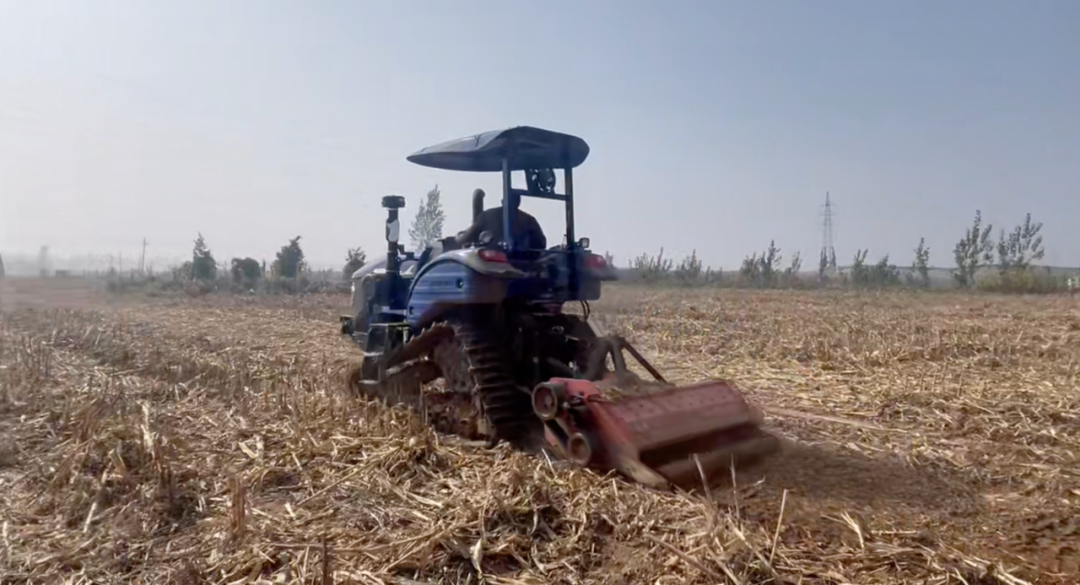
◉ A maize straw shredder in North China. Photo credit: Xianzi
Another response is passive resistance. In Quzhou, someone mentioned that to get the sowing done at all, farmers have no choice but to rake out the surplus maize straw and dump it somewhere deserted on the edge of the village.
‘The village is nervous too — worried about fire,’ he said. ‘What can you do? They won’t let you burn it. Where’s it supposed to go? In the end, it all gets hauled out to a useless pit beyond the village, and they find an excavator to bury it.’
Still “returned to the field”, in a manner of speaking.
Pests and Diseases
Wheat straw may be the easier one to deal with — no need to till it in — but that’s precisely why it’s more likely to harbour pests. A farmer in Fengfeng Mining District said there are more bugs on wheat than on maize, because after the wheat harvest, roughly 20 centimetres of stubble are left standing in the ground. “Inside the hollow wheat stems, that’s where the bugs set in.”
“Aphids are terrible this year,” he said. Just over a fortnight before I arrived, he had already sprayed once. As we chatted, he was watering the wheat and planned to wait a few days after the watering, then spray again. He had noticed that ever since straw return took effect, there were clearly more pests. Crouching at the edge of the field, he gestured emphatically to describe what you see if you don’t spray — the wheat’s main stems swarming with dense clusters of black aphids. To keep them down, he said, pesticide use had gone up by at least a third.
Farmers in Quzhou said that before straw return, spraying was far less frequent. Now they have to spray at least two extra rounds per crop. “These days, both wheat and maize need several sprays. No spray, no crop.”
Weeds have increased too. He reckons straw return chops up the weeds along with the straw, dropping their seeds into the soil where they breed endlessly. “And there are more kinds of weeds than before. I’m forty, fifty years old, and I’ve never seen such a mess of grasses — all sorts, I don’t know where they came from. Some flower, some don’t. Before, it was just the same handful of weeds in the field.”
More spraying rounds naturally means higher costs. Spraying one mu costs around 20 yuan per pass, but the Quzhou farmer felt the pesticide itself wasn’t the real expense — it was the labour. He runs a livestock farm on the side and has no time to tend the fields. His parents are nearly eighty, and he won’t let them keep farming. So he has to hire people to spray.
That is also why Zhao Qinxu keeps insisting that the tilling depth must be properly maintained, because thoroughly incorporating straw into deeply buried soil helps suppress pathogens, pests and weed seeds.
Take the double-spotted noctuid moth, for instance. Hebei is where this pest was first detected on summer maize in China. Since it was first recorded in 2005, it spread rapidly across Hebei and the Huang-Huai-Hai summer maize zone around 2011, prompting Hebei to take the lead in drafting local pest-control protocols. In 2017, Farmers’ Daily interviewed several experts who noted that the outbreak of the double-cut corn earworm was not caused by any single factor but was closely linked to new farming practices in the wheat–maize double-cropping zone, such as mechanical harvesting with straw return and no-till sowing.
Once wheat straw is returned to the field as surface mulch, it creates a shaded micro-environment at the base of the maize seedlings — an ideal habitat for double-cut corn earworm larvae, which thrive in cool, damp conditions. The mulch layer also shields the larvae from pesticide sprays, acting as a near-perfect refuge. Plant-protection experts at the Hebei Academy of Agricultural Sciences recommend either removing and baling the wheat straw off-field or breaking up that soft, thick, blanket-like straw layer — for instance, by shredding it finer so it cannot form a continuous cover, using a stubble destroyer to chop the wheat residue and press it flat against the ground (reducing the larvae’s room to move), or clearing straw from the sowing rows.
The last point is strikingly similar to a local workaround Zhao Qinxu picked up from the old-timers: once the wheat is up, you set aside clear strips for the maize sowing rows and plant the maize into those bare strips, so the new crop has less contact with the wheat stubble — which to some extent cuts down on pests and disease.
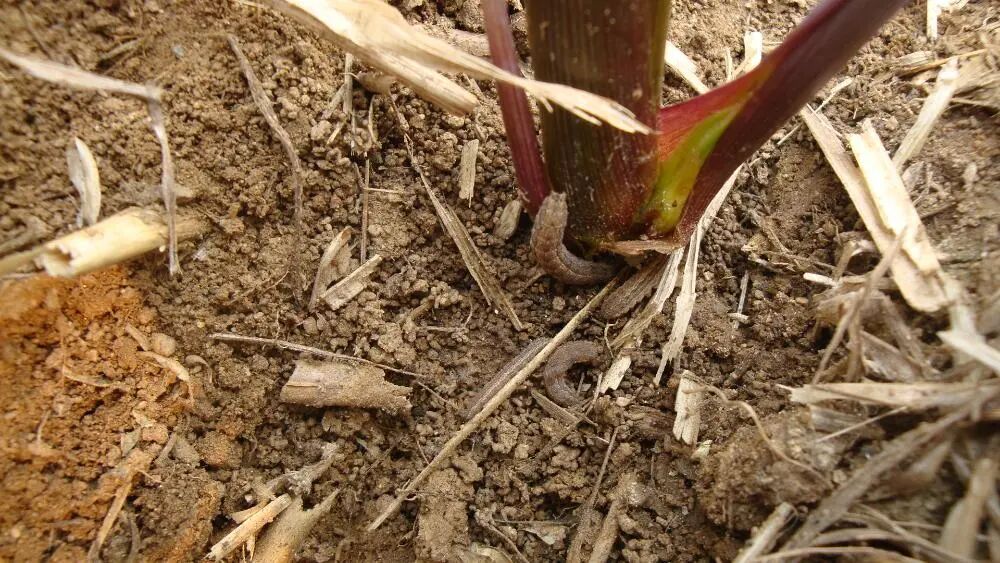
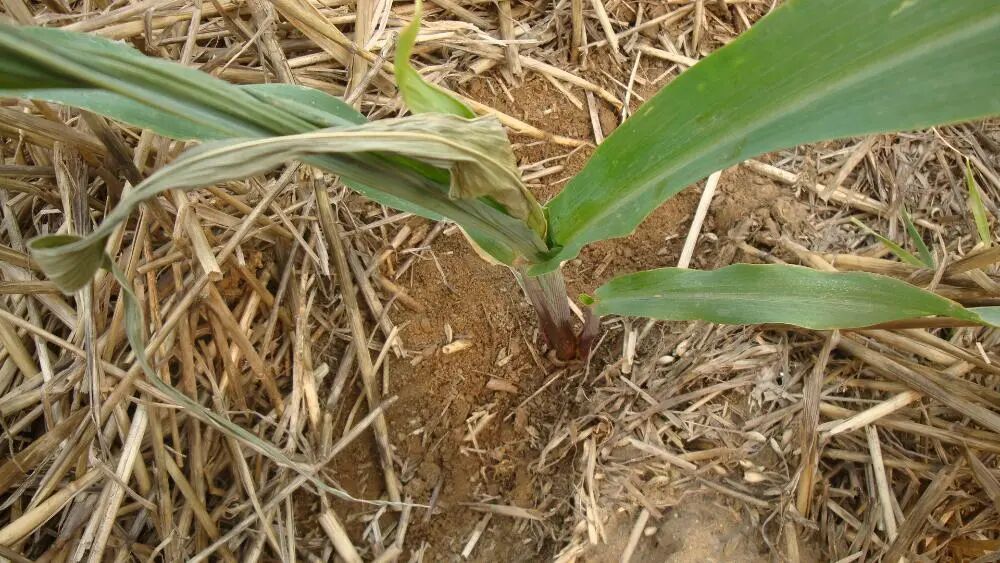
◉ A maize dead-heart seedling damaged by the double-spotted noctuid moth. The straw cover gives the larvae a cool, damp hiding place. Photo credit: Lingshuo County People’s Government
The Numbers
Run the numbers, and the added costs of straw return fall mainly into these buckets: pesticides, machinery (straw shredding, rotary tillage and so on), seed, and labour.
When I interviewed a large-scale grain farmer, I asked him to itemise the costs at every stage of crop production. One interesting finding is that straw return may impose a heavier burden on smallholders.
First, whether it is straw shredding or rotary tillage, both large and small farms need machinery to get it done. But operators charge the big growers less. “They don’t fancy moving the machine about. Give them one big block and there’s no need to keep shifting — they’ll happily knock a little off the price.” The smallholders were understanding about this, too. For instance, rotary tilling one mu typically costs a large farm 25–30 yuan; a smallholder pays 40.
Second, large farms use drones to spray pesticides and herbicides at roughly 4–5 yuan per mu. If straw return leads to more pests and weeds, spraying costs rise accordingly. The big growers find this manageable. But for smallholders who spray by hand, it all boils down to one extra chore that’s a real nuisance. Since they usually spray themselves, they can’t give a precise figure for the economic cost — they just grumble, “It’s just too much bother.”
It is precisely these tiny, unrecorded “bothers” — invisible to cost accounting and ignored by everyone — that pile up into a farmer’s very real hardship, keeping the urge to burn straw nagging away at the back of their minds.
In 2023, Zheng Jiaxin, a sociology doctoral student at Wuhan University, concluded after fieldwork in Anhui that because smallholders bear higher mechanisation costs for straw return, among other factors, the policy has effectively accelerated small farmers’ exit from the land. I did not see this playing out in Hebei. The farmers said that while farming doesn’t pay, they would keep at it. After the pandemic, job opportunities dried up, and some villagers who had been working in other provinces came home, took up farming, and picked up odd jobs nearby during the slack season. All in all, for farmers the land remains their last refuge.
An elderly farmer in Daming County came across a “straw-return packet” on Kuaishou and went to an agricultural-supplies shop to buy some himself to try out. Just over ninety yuan for three packets, which he spread over five or six mu of land, hoping the maize straw would decompose a little faster. Did it work? “I reckon it rotted a bit quicker,” he said. But when I pressed him — would he use it again next year? — his reply was vague: “We’ll see after the New Year.”
Indifference, a kind of shrug — that was the prevailing attitude towards straw return I sensed among the farmers during my fieldwork in Hebei. They will complain about poor germination, more pests and other fallout from straw return, but when it comes to yields, they always say, “Not a big deal.”
Even they themselves sometimes find that conclusion odd. Then they reason it through: many things affect yields. Maybe the irrigation works the government has recently built have secured the water supply? Maybe the quality of fertiliser and seed has improved? But however it comes about, as long as the yield loss isn’t too severe, they can live with it. “If I can get a bit of money out of it, that’ll do.” After all, you can’t count on farming to make money.
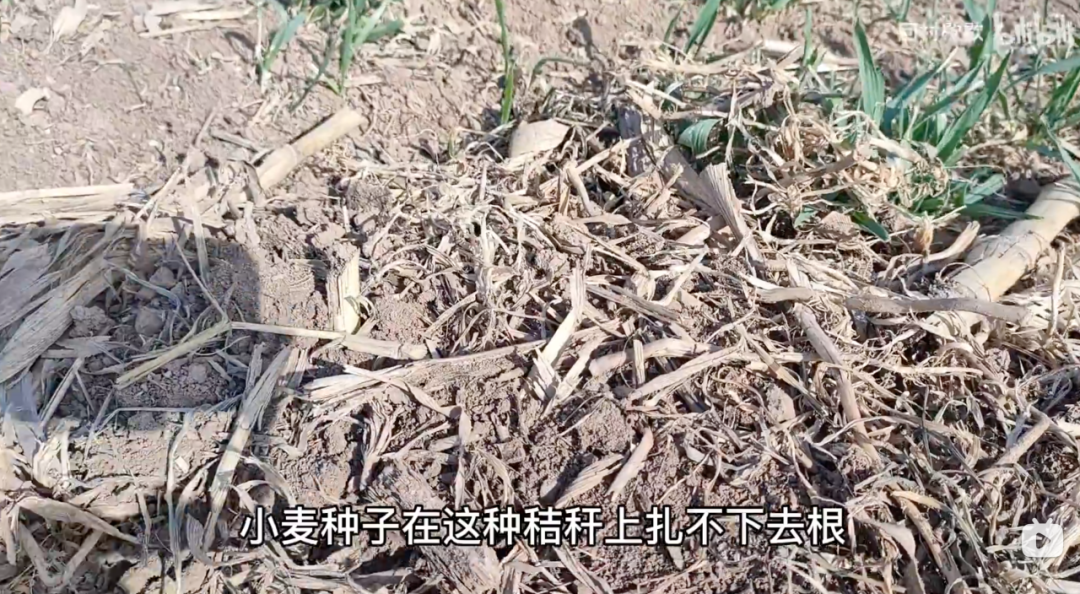
◉ If maize straw is not shredded finely enough and does not mix thoroughly with the soil, wheat seed cannot root deeply enough and germination suffers. Photo credit: Bilibili creator “Huicun Xiexie”
Baling
Even though they have grown used to straw return and it has not much affected yields, the farmers interviewed all reached the same conclusion: they would still rather burn. Once the straw is burned, the field is clean, easy to work, and there are fewer pests.
A smallholder farms twelve mu. Right at the edge of his land, a large-scale grain grower from the neighbouring municipality has leased eight hundred mu. One year he watched that big grower bring in a large machine to bale up all the straw and haul it away. He was rather envious and has always hoped someone would come and collect his straw too. “I ask them to come and bale, but they say my plot’s too small — they won’t touch it.”
But farmers who have had their straw baled tend to grumble more than anything. A household in Feixiang, for instance, recalled that over a decade ago, when burning was first banned, people came to bale the wheat straw. “The machine makes one pass over the field to bale it, then another to pick up the bales,” he said. “Normally you could sow the maize straight in. But all that back-and-forth just packs the soil hard.”
He didn’t know whether those bale operators were receiving state subsidies. Either way, “if the subsidy doesn’t reach the farmer, who’d pay someone to drive over his land for nothing?”
Weighing the lesser of two evils, he finally decided to plough the straw back into the soil.
A couple of years ago something else happened that deepened his distrust of letting machinery operators onto his land. Some years back the government had been promoting subsoiling, subsidising operators to break up the soil for farmers. “They just cut a few furrows through your field and call it free — not actually turning the whole thing over, just leaving it all grooved up, and that makes ploughing harder afterwards,” he said. After operators botched the job like that, farmers refused to let anyone come and subsoil their land anymore.
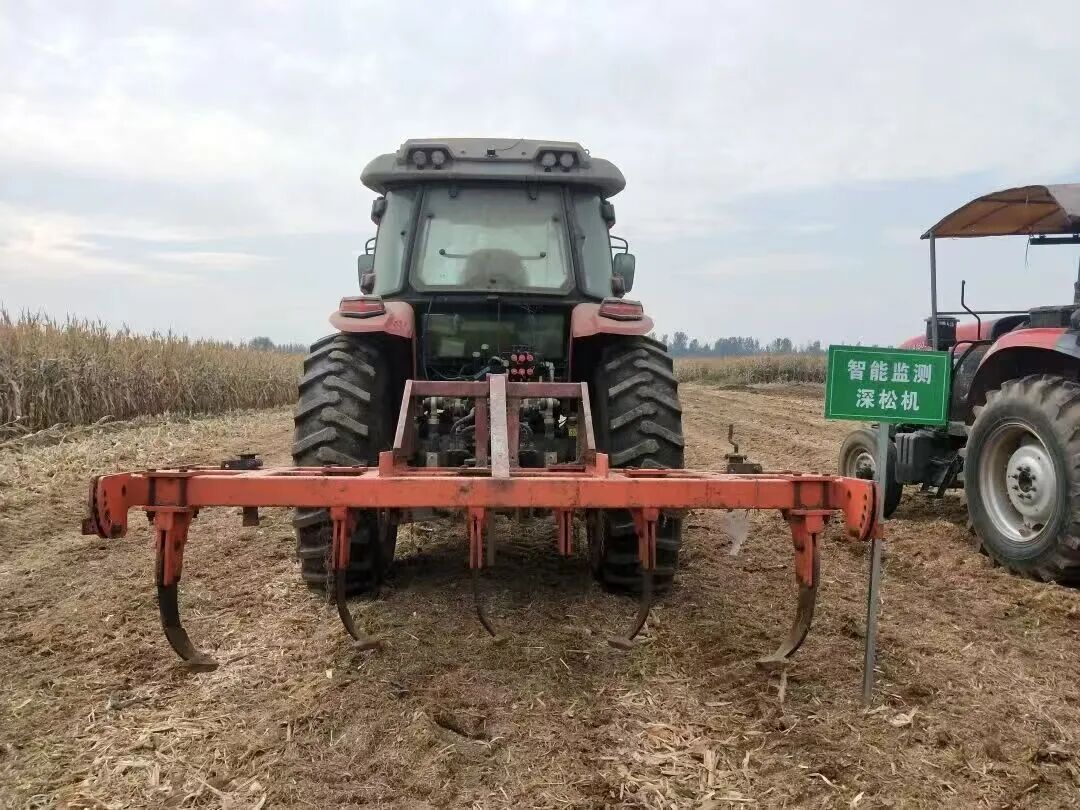
◉ To improve farmland quality, the central government has allocated funding year after year to support mechanised subsoiling and land preparation. But just like straw return, once implementation falls short, it actually gets in the way of farmers tending their land. Photo credit: Handan New Agriculture
Decades of fertiliser and pesticide use on top of intensive cropping have drained the land’s nutrients. And that is precisely the problem straw return aims to address — replenishing organic matter, improving soil structure, and sustaining long-term fertility. But have the farmers felt the benefit? Everyone I met agreed: the soil really has become looser, no longer compacted. Zhao Qinxu also said that incorporating maize straw into the soil does raise organic-matter levels — you can tell just by looking at the colour. “Go to a farmer’s field and you can see the topsoil is darker. Run a test and you’ll confirm the organic-matter content has gone up too.”
But farmers have not cut back on fertiliser. Mainly for two reasons. First, straw adds organic matter to the soil, but the available nutrients crops need to absorb still come chiefly from fertiliser. Second, many parts of China in fact have an over-application problem: because farmers don’t know what their soil actually contains, they rely on experience — and on the fear of losing yield — to keep applying the same (or even more) fertiliser as before.
The mindset is still that “more fertiliser is always better.” This also hampers their understanding of how straw return relates to soil health. Only when straw return is combined with measures such as soil-testing-based formulated fertilisation and nutrient balance management is improved fertility more likely to translate, gradually, into reduced fertiliser use. And how does one truly understand the soil? That is both a knowledge blind spot for farmers and a gap in grassroots agricultural-extension services.
Straw return has become a widely accepted farming practice across the North China Plain, yet farmers have not wholeheartedly embraced it.
– This is Foodthink’s 834th original piece –

Foodthink
Author
Kong Lingyu
Project Director at Foodthink. Focuses on climate, environment, and food and farming issues.
At the interviewee’s request, Zhao Qinxu is a pseudonym used in this article.
Edited by: Pei Dan
Layout by: Xiao Shu
Scan the code to tip and support original foodthink writing
▼

▼
Tap the image to read related articles
▼
Tap a keyword to view more articles in the collection
Seeds | Farming Techniques | Policy | Fermentation | Nutrition | Fruit | Fisheries | Events | Jobs | Takeaway | Wet Market | Livestock | Food Talk | Sharing Sessions | Reading Group | Harvest Festival | Smallholder Stories | Climate Change | Rural Development | Cooperative Economy | Urban Farmers | Food Safety | Digital Technology | Biodiversity | Pandemic and Food | False Solutions | Agroecology Internship Programme
Beijing | Hebei | Shanghai | Guangdong | Guangxi | Henan | Sichuan | Jiangxi | Xinjiang | Shaanxi | Hong Kong | Chongqing | Zhejiang | Jiangsu | Guizhou | Taiwan | Inner Mongolia | Philippines | Canada | Russia | Mexico | Italy | United States | United Kingdom | Germany | Netherlands | Thailand | Sweden | Japan