Ren Yingying of Lianxiang Farm was invited by the German Federal Ministry of Food and Agriculture to the GFFA in Berlin. The position paper she co-drafted demands breaking multinational corporations’ control over seeds, land and supply chains, promoting agroecology, and safeguarding smallholder farmers’ land and policy-participation rights.
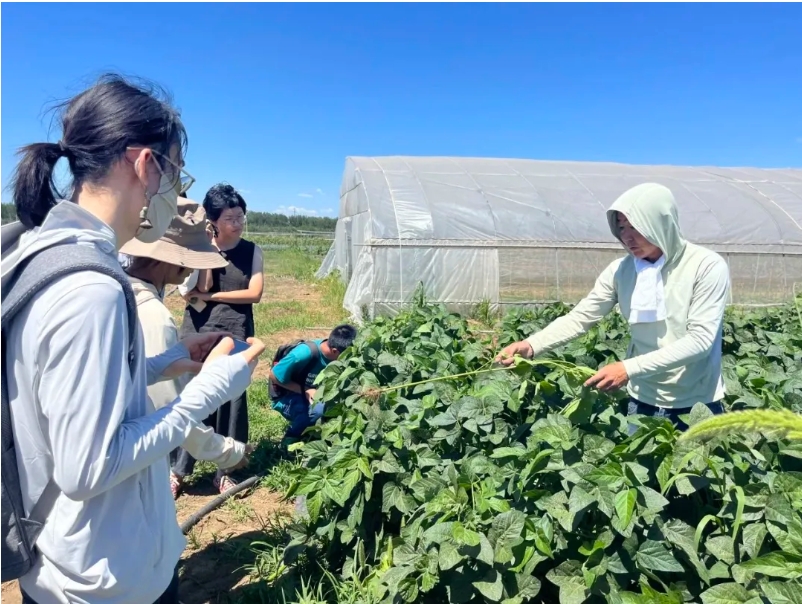
Among the more than ten ecological farms Foodthink visited, new-generation farmers bring wildly diverse professional backgrounds. Above the shared bottom line of no chemicals, from five mu of intensive cultivation to a garden-style life, every farm is the embodiment of its owner’s ideals.
In a small ranching town in Texas, Zhang Yiqing buys eggs directly from free-range backyard hens and small organic farmers, sidestepping supermarket purchase limits and price hikes. She believes decentralised local food systems are the real solution to the egg shortages intensive farming keeps causing.
Qiaoyi’s family in Ruyuan, Shaoguan, moved from the deep Nanling Mountains to beside Danxia Airport. In summer, colony after colony of wild termite mushrooms lets the Guoshan Yao carry on their days living with the mountains and forests in the gaps of urbanisation.
Soya beans, mung beans and adzuki beans all originate from China. Following the Silk Road and the footsteps of migrants, they took root in miso, fermented bean curd and Southeast Asian kitchens, weaving together a history of the dining table that spans continents.
Zejun refused the mainstream path of life. In spring 2024, a three-month internship at Guixinyuan Farm in Huizhou, Guangdong—from weeding and feeding ducks to visiting multiple farms across the two Guangs—gradually revealed that ecological agriculture has no standard answer but a spectrum.
Sangje, a herder settled in the county town driving a sanitation truck, cannot afford his own yak meat—he boils imported frozen meat with sheep intestines in one pot. Cheap JBS-chain beef is driving live livestock prices into loss, from Gannan to Brazil, and burning the Amazon’s forests.
In 2011, Yu Jiangang took part in rural development in Zhuang villages in Longzhou, Guangxi. In 2024, he returned to Bangui hamlet to find the water buffalo all but vanished, the village school down to just 5 pupils, and the village still living to its own rhythm.
From the labour order of delivery riders to the insights into symbiosis offered by mycelial networks, more than ten new books published in 2024 across food, agriculture and ecology record the hope intertwined with contradictions between people, land and nature.
Foodthink Founding Editor Chang Tianle and Sijia, host of 100 Ways of Living, chat about ecological agriculture, supporting local farmers, and how office workers can still cook proper meals without ordering a takeaway.